Tulum's Airport Just Got a Major Vote of Confidence
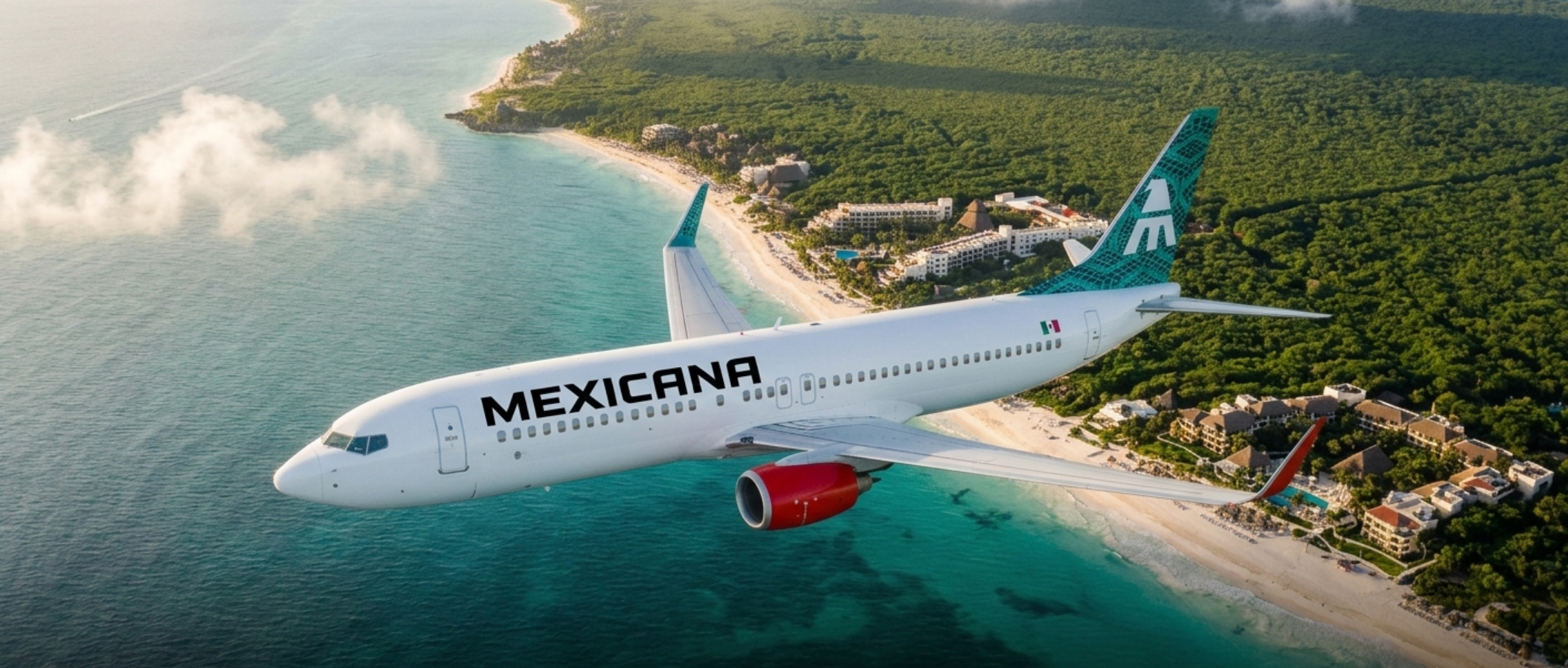


Eight new flights is a small number. The machinery assembled to deliver them is not. Here is what the Mexicana announcement actually tells you about where Tulum sits right now, and what to watch next.
What was announced
On July 10, federal and state authorities announced that Mexicana de Aviación, the state-owned carrier, will add eight domestic frequencies through July and August, backed by a national advertising campaign. The move came out of the Coordination Table for the Tourism Relaunch of Tulum, a working group bringing together the federal government, the state of Quintana Roo, the airline, and the local tourism sector. Governor Mara Lezama is leading the effort on the state side, described by officials as part of President Claudia Sheinbaum's push to strengthen national connectivity.
The number that matters is not eight
Eight frequencies over two months will not transform an airport. Taken alone, it is a modest schedule adjustment. What makes the announcement worth reading closely is everything attached to it.
The state government, through its tourism promotion council (CPTQ), produced the advertising materials and a national media campaign across digital, radio, television, and print, and made them available to Mexicana at no cost to the airline. That detail is the story. A state marketing budget is being spent to de-risk a route for a carrier. More than 200 hotels in Quintana Roo are taking part through the CPTQ's Vacation Specials platform with exclusive offers. In August, Governor Lezama will meet with more than 300 travel agents from the Mexico City metropolitan area. Talks are underway with Viva Aerobus and Volaris to expand service further.
Count the participants: the federal government, the state government, the national flag carrier, the hotel sector, and the travel trade. That is a lot of institutional weight behind eight flights, and it is the weight, not the flights, that signals intent.
.jpeg)
The context nobody should skip
Tulum's airport has had a difficult 2026. According to aviation data reported by the trade outlet Reportur, international traffic fell by more than 30% over the year, with the number of international routes dropping from twelve to four.
Twelve to four is a severe contraction, and it deserves to be stated plainly rather than buried. But it needs context to be read correctly. The airport opened only in December 2023. New airports routinely overshoot on opening schedules, then correct as airlines discover what demand actually exists rather than what was projected. Airlines are not abandoning Tulum out of pessimism. They are re-pricing optimism. That is a normal, if uncomfortable, phase in an airport's life.
The honest read is that both things are true at once: the pullback is real and significant, and the response to it is unusually coordinated. Anyone selling you only one half of that is selling you something.
The sixteen-year backstory
One more piece of context makes the 2026 contraction easier to read, and almost nobody includes it. The current airport is the second attempt.
On March 22, 2010, President Felipe Calderón announced the Aeropuerto de la Riviera Maya: a 1,500 hectare site in Tulum municipality, budgeted at 3.2 billion pesos, sized for three million passengers a year, to be built and operated under a fifty-year private concession. The SCT published tender documents that April. Grupo México bid in consortium with Grupo Aeroportuario del Pacífico. Tradeco bid against them.
In May 2011 the SCT declared the tender void, finding that none of the technical offers met the requirements. Grupo México challenged the decision in court. The Calderón administration never reopened the process. Under Peña Nieto, the transport ministry said it would evaluate a relaunch and never did. By April 2014 the airport had disappeared from federal communications entirely.
The project returned in October 2020, restructured. The private concession became a military build, folded into the Tren Maya corridor. It opened on December 1, 2023.
Two things follow from that history. The first is that the demand case for a southern Riviera Maya airport was identified, costed and tendered by the federal government a decade before Tulum became a global destination. Travellers were already landing in Cancún and driving two hours south, and the state had already decided that was a problem worth 3.2 billion pesos. The federal case for this terminal was made before the destination existed in its current form.
The second is that its viability has been argued over for the entire sixteen years. In 2020, civil engineers were publicly questioning whether a terminal 130 kilometres from Cancún could be justified at all. The route contraction of 2026 is the current chapter of an old argument, and it is worth knowing that the argument predates the airport, the boom and the pandemic. Federal commitment to this corridor has now outlasted three presidents and two parties. That is the durable fact sitting underneath a volatile year.
Why this matters beyond aviation
Air connectivity is not a tourism statistic. For a destination like Tulum, it is the underlying infrastructure that supports visitor volume, rental occupancy, second-home demand, and ultimately property values. Routes determine who can get here, how easily, and at what price. When routes contract, the effects reach the rental market before they reach the headlines.
This is why the intent behind the announcement is more useful to a property owner than the flight count. The question is not whether eight domestic flights move your occupancy, because they do not. The question is whether the institutions that shape Tulum's connectivity are committed to rebuilding it. On the evidence of July 10, they are, and they are willing to spend public money proving it.

The domestic pivot is a strategy, not a consolation
The summer campaign targets Mexico City, the State of Mexico, and Hidalgo. It is easy to read a domestic push as a downgrade from the lost international routes. That would be a misreading.
Domestic travellers are closer, cheaper to attract, more repeat-prone, and far less exposed to the currency swings and long-haul economics that make international routes fragile. Building a domestic base gives an airport a floor. International routes are the upside. Domestic volume is the foundation that keeps terminals viable while that upside gets rebuilt. Officials have been explicit that this is a first phase to be evaluated and continued into the winter season, which is precisely how you would sequence it if you were building a base rather than patching a hole.
What to watch next
The announcement is a signal. These are the things that will tell you whether it becomes a trend:
Whether the winter continuation actually happens. Officials framed summer as phase one. A quiet non-renewal would say more than the original announcement did.
Whether Viva Aerobus or Volaris commit. Mexicana is state-owned, so its participation is partly political. A private carrier adding capacity is a market judgment, and that is the stronger signal.
Whether international routes stabilise or keep falling. Four is the current floor. Watch whether it holds.
Load factors, not route counts. Full planes on fewer routes are healthier than empty planes on many. The route number is the headline. The load factor is the truth.
Whether the August travel-agent push converts. 300 agents is a distribution channel, and distribution is how domestic volume actually gets built.

The bottom line
Airports go through cycles, and this one is still finding its level. What stands out is that when international traffic dipped, the response was not to wait it out but to coordinate three levels of government, the national carrier, and the hotel sector around rebuilding it, and to keep spending public money doing so.
That level of institutional commitment is a clearer signal of where authorities expect Tulum to go than any one quarter's flight numbers. It does not erase the 30% decline, and it should not be read as a guarantee. But it does tell you that the people with the most information and the most at stake are not treating Tulum as a destination in retreat. They are treating it as one worth investing in through a soft patch, which is a very different thing.

Itza II | 2 Bedroom Furnished Apartment with Private Jacuzzi in Aldea Zama, Tulum

Maison Siscolino | 4 Bedroom Villa with Swim Up Pool and Rooftop Plunge Pool in Region 15, Tulum
Maison Siscolino, Region 15 Tulum. Furnished four bedroom villa, 245 m² on a 301 m² lot with swim up pool and rooftop plunge pool.
Follow our Tulum market reporting in Google.
Add to preferred sourcesWe are the ultimate guide to invest in Tulum
The complete guide to buying property in Tulum. Find homes for sale, condos or land and consult with an experienced real estate advisor.
News: Real Estate, Lifestyle and Growth Across the Riviera Maya
The latest from Tulum, the Riviera Maya and the Mexican Caribbean, from market trends and investment opportunities to lifestyle and the infrastructure shaping the coast.