Tulum’s Public Transport Pilot: Five Routes, Fixed Fares, and What It Changes for Residents
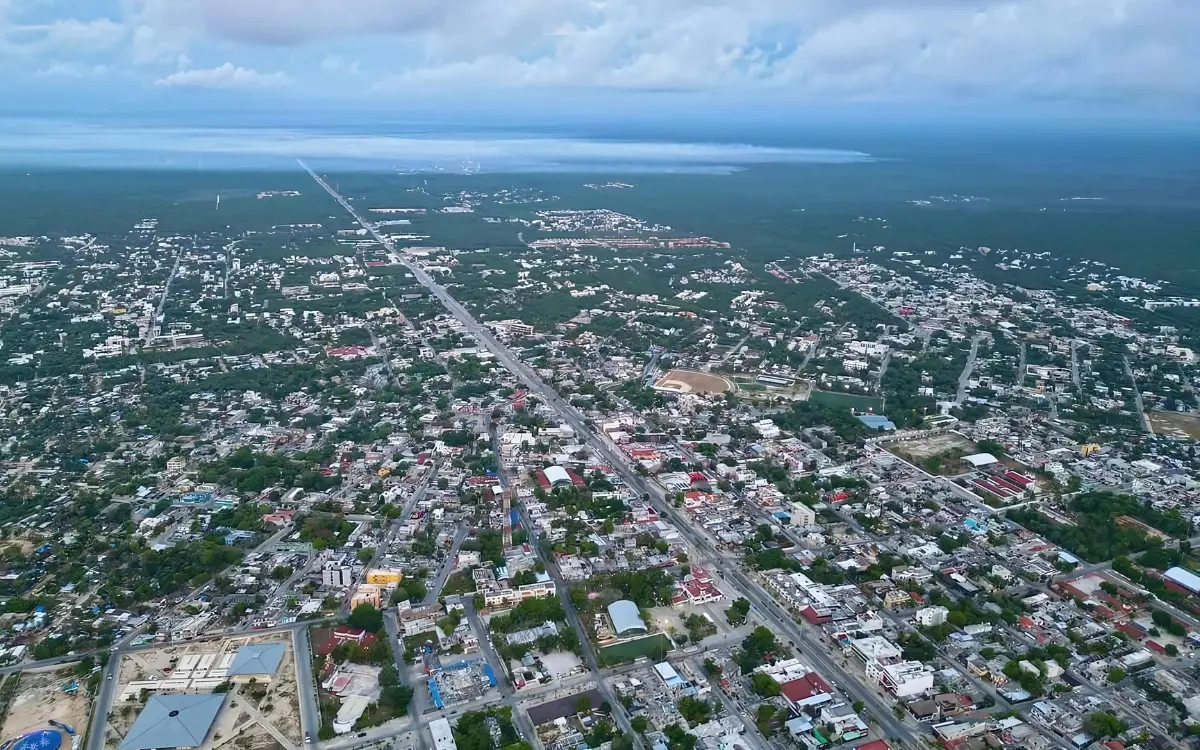


Tulum’s First Fixed-Route Buses Begin Running in La Veleta and Aldea Zama
Tulum has begun operating its first fixed-route public bus system, replacing the informal colectivo network that has served as the town’s primary mass transit for fifteen years. The pilot, launched September 28 by the municipal government under the Plan Tulum Renace infrastructure package, introduces five scheduled electric minibus routes connecting Tulum Centro, La Veleta, Aldea Zama, Region 15, and the Hotel Zone arch.
The shift from informal to formal transit is a structural response to a problem that has worsened every year since 2019: Avenida Tulum and Avenida Coba are now functionally saturated during peak hours, and the *colectivo* system that once served a town of 30,000 cannot scale to a municipality approaching 150,000 residents plus seasonal tourism. The question for property owners is whether this pilot represents genuine institutionalization of civic services, or another announcement that fades before the next administration.
The five lines are limited in scope. Line 1 runs from the ADO bus station to the Hotel Zone arch, covering the full length of Avenida Tulum. Line 2 connects La Veleta to Aldea Zama via Avenida Coba. Line 3 serves Region 15 and the northern residential zones east of the highway. Lines 4 and 5 are short-loop connectors within the downtown core, linking the municipal palace, the central market, and the new recycling center. The fleet consists of 20 electric minibuses, each with a capacity of 24 seated passengers. Fares are fixed at 15 pesos per ride, payable via a new municipal app (*Movilidad Tulum*) or a contactless card available at the ADO terminal and three convenience stores in Centro. Buses run every 20 minutes from 6 AM to 10 PM on weekdays, and every 30 minutes on weekends.
Unlike the colectivos, which negotiated fares informally and deviated from routes based on driver preference, these buses adhere to published timetables. GPS tracking is active, and real-time location data is available in the app. The municipality has stated that adherence to schedule will be a condition of operator licensing. The drivers are not new hires. They are former *colectivo* operators who have been integrated into a newly formed municipal cooperative, Transporte Público Tulum A.C. Membership requires passing a safety inspection, completing a 40-hour training course on customer service and route discipline, and adopting the fixed fare structure. Approximately 60 drivers have joined so far; the municipality estimates 120 eligible operators remain outside the system.
Mayor Diego Castañón Trejo described the integration as “the end of improvisation” in a press conference on September 28. He noted that the cooperative model was chosen over full municipalization to preserve operator livelihoods while imposing standards. Whether this balance holds depends on enforcement: if unlicensed *colectivos* continue operating parallel to the fixed routes without penalty, the economic incentive to join the cooperative weakens. Three gaps are material. First, there is no dedicated bus lane on any segment of Avenida Tulum or Avenida Coba. During peak hours (7–9 AM, 5–7 PM), the electric minibuses sit in the same traffic as private vehicles and taxis. Without priority right-of-way, schedule adherence degrades precisely when reliability matters most.
Second, coverage does not extend to Soy Tulum, Pino Suárez, or the airport corridor. These are among the fastest-growing residential zones and the ones most dependent on private transport. The municipality has signaled intent to add Lines 6 and 7 in Q1 2027, contingent on the pilot meeting usage targets of 1,500 daily riders across all five lines by December 2026. That target has not been publicly confirmed or denied as of this writing. Third, there is no integration with the Maya Train station. The nearest bus stop to the Tulum Maya Train station is 1.2 kilometers away, requiring a walk along an unpaved shoulder. For a system marketed as modernizing Tulum’s connectivity, this gap undermines intermodal utility. A shuttle connector has been proposed but not funded.
For long term tenants and residents without cars fixed route transit reduces daily friction. Predictability matters more than speed. Knowing a bus arrives every 20 minutes allows planning that waiting for an unpredictable colectivo does not. This supports year round occupancy in zones served by Lines 2 and 3 particularly La Veleta and Region 15 where rental demand from remote workers and service sector employees is highest. For property values the impact is micro location specific. Homes within 200 meters of a confirmed stop may see modest rental premiums while homes beyond 500 meters see no direct benefit. Crucially the system does not change the fundamental calculus for luxury or beachfront property where buyers expect private transport regardless of public options.
For developers the signal is about municipal capacity. If Tulum can sustain a regulated transit system through an election cycle and budget constraints it suggests other civic services such as waste management permitting and water security are also being institutionalized. That reduces the emerging market risk premium embedded in valuations. If the pilot collapses within six months it reinforces the opposite narrative. The pilot is small but the direction is legible. Tulum is attempting to transition from informal to formal urban mobility. The test is not whether the buses run today. It is whether they still run in March 2027 after the winter season stress tests the system and the next municipal budget is approved. Watch three indicators. Whether Lines 6 and 7 are announced by January. Whether unlicensed colectivos are enforced against or tolerated. And whether the app shows consistent schedule adherence during peak hours. If two of three are positive the system is consolidating. If none are treat it as a campaign promise with wheels.
Sources: Municipio de Tulum Plan Tulum Renace Movilidad Sustentable September 28 2026. Transporte Público Tulum A C cooperative charter and driver roster September 25 2026. Secretaría de Movilidad de Quintana Roo Programa Estatal de Transporte Público 2026–2030 August 2026.

Itza II | 2 Bedroom Furnished Apartment with Private Jacuzzi in Aldea Zama, Tulum

Maison Siscolino | 4 Bedroom Villa with Swim Up Pool and Rooftop Plunge Pool in Region 15, Tulum
Maison Siscolino, Region 15 Tulum. Furnished four bedroom villa, 245 m² on a 301 m² lot with swim up pool and rooftop plunge pool.
Follow our Tulum market reporting in Google.
Add to preferred sourcesWe are the ultimate guide to invest in Tulum
The complete guide to buying property in Tulum. Find homes for sale, condos or land and consult with an experienced real estate advisor.
News: Real Estate, Lifestyle and Growth Across the Riviera Maya
The latest from Tulum, the Riviera Maya and the Mexican Caribbean, from market trends and investment opportunities to lifestyle and the infrastructure shaping the coast.